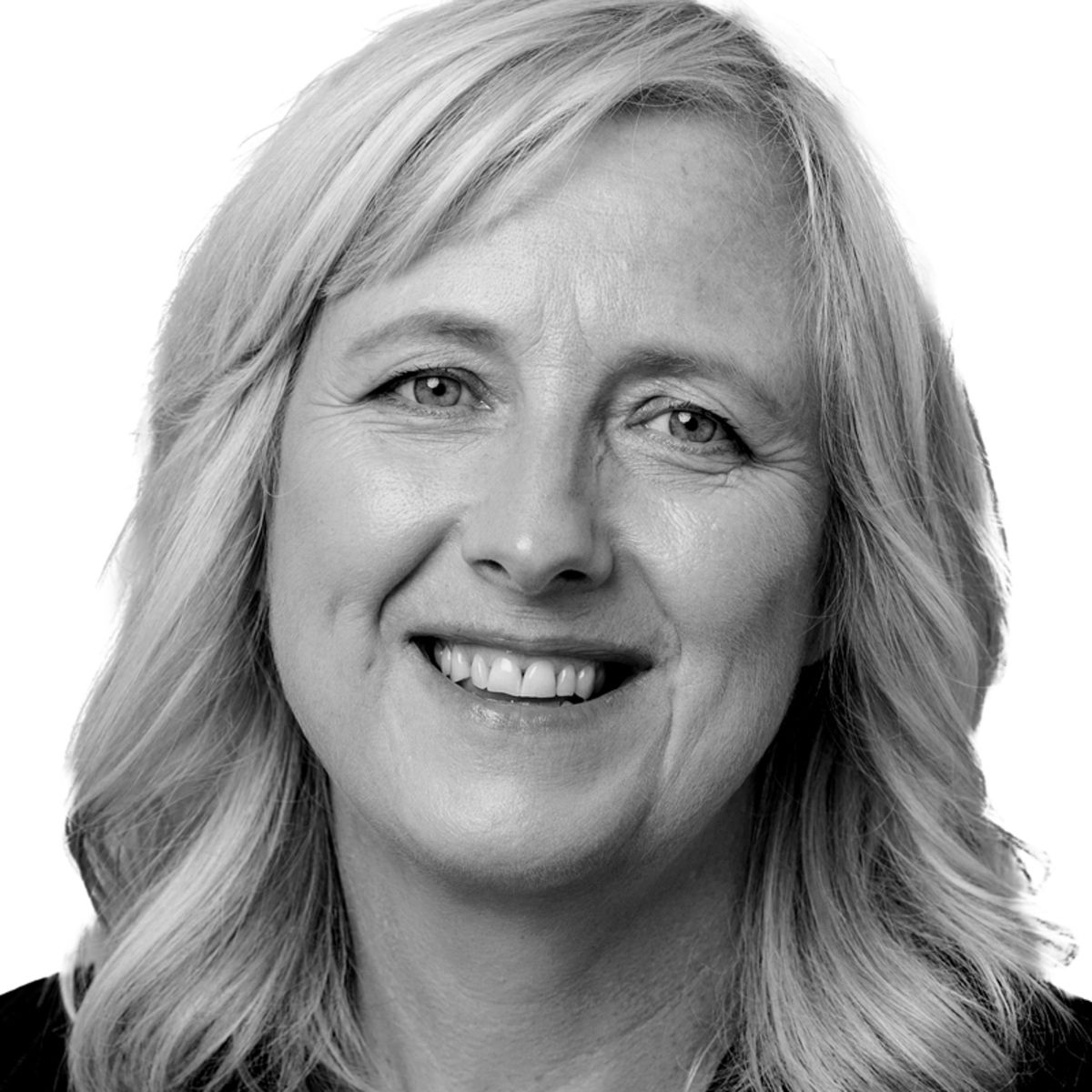

Facebook whistleblower Frances Haugen. Photo: Peter Rae/ Getty
Frances Haugen was not a natural whistleblower. She was a true believer, a data scientist who believed the company’s mission that “connecting” the world would lead to sunlit uplands of peace, love and outbreaks of democracy around the world. Slowly, she began to realise this was not the case.
The result is depicted in The Social Reckoning, Aaron Sorkin’s long-awaited sequel to The Social Network, which opens nationwide on Friday. Haugen brought thousands of documents out of the firm, laboriously photographing them one by one and handing them over to Wall Street Journal journalist Jeff Horwitz.
I met Haugen back in 2021, when she came to Britain to give evidence to parliamentarians shortly after testifying in front of Congress, and in the five years since, less than nothing has happened to hold Facebook – now re-named Meta in an ultimately futile attempt to wipe the stench of scandal off it – to account, or any other Silicon Valley tech firm.
Mark Zuckerberg, like all the other bros, has enjoyed total impunity despite playing a “determining role” – the United Nations’ words – in stirring up a genocide in Myanmar and, as we see in the film, fomenting an insurrection.
There has been no justice and no accountability. Eight years after the Nerve team – then at the Observer – published the evidence of another whistleblower, Christopher Wylie, and kicked off the Cambridge Analytica/Facebook data scandal, nothing has structurally changed and no one has been held to account.
But The Social Reckoning brings a little glimmer of hope. Hollywood has woken up from its decade-long slumber and has started to take notice. The film is the start of an autumnal season of features and docs tackling different parts – and people – of Silicon Valley. There’s still no accountability but at least we get to see Jeremy Strong [he plays Zuckerberg] with a Caesar haircut method-acting what a total lack of human empathy looks like in cinemas across the globe.
Tomorrow night, I’m moderating a panel after a screening of the film with Haugen and another of its characters: Roger McNamee, a former Facebook investor who tried to warn Zuckerberg of the harm he was causing way back in 2016. It’s taken a decade, but as the AI bros look set to unleash more unregulated, unsafe technology on an unsuspecting public, could this film be a sign that the world is finally waking up?
Maybe. I hope so. Because we have the power to stop them. That’s what Frances Haugen says in this interview. For all our sakes, we have to hope that people will finally start listening.
Carole: What's it like seeing yourself on the big screen?
Frances: It's surreal, and a huge honour. Aaron Sorkin has a long history of making films about democracy, about journalism and about our power to change society, so for him to pick my story was amazing. It's definitely "inspired by", not "based on" – a lot of it is a little Hollywoodified. But it was fun to revisit that chapter. There were things I knew for sure when I first went to Jeff [Horowitz, the Wall Street Journal reporter] and things we didn't – we were pencilling the lines together, working out how it all connected.
Did the character feel like you?
My mother has decided to be aggrieved on my behalf, because I am very tall and I was much blonder when I was younger, and they have cast a short, brunette actress [Mikey Madison]. So she's like “blonde people can be smart too”. But, you know, that's my mother, not me. The places where it's most "inspired by" is the timeline. They need to make it watchable and a lot of the things happened on a rather condensed scale. Probably at least half of what I was able to get out, we got out in a couple of weeks. And there's a choice to link the events of January 6th and the contents of my disclosures. In actual real chronology, I came forward as a whistleblower about nine months after January 6th, which allowed me to document it while I was inside the company. Those timelines are a little more interwoven in the movie.
I wondered if you had any kind of flashbacks watching the film. But it's actually been a positive experience for you?
‘It's not free to keep a secret. You are a human being first, you're a citizen second and you're an employee third, and your fellow human beings need you’
It was more like a nostalgia ride than it was traumatic. I was very lucky. A lot of whistleblowers get PTSD because they go through the whole experience alone. During that period of time, I was largely living with my parents, and so they heard my conference calls and we could talk about it over dinner. And Jeff and I had a much more egalitarian partnership than is depicted in the movie. I chose to work with him because I think he's one of the best journalists in terms of understanding how tech works. But in the film he takes on the role of the audience – you need to have someone that you get to do all the exposition to.
You photographed 20,000 pages of internal documents. Only a handful of Facebook insiders have gone public out of the scores of employees who must have seen similar things. Why so few?
Taking 20,000 photos is hard – I had back problems by the end.
One reason is that there's actually very few people who are well versed in how these systems work. When I was at the company, maybe somewhere between 30 and 100 people understood how these things worked. We should have a public discussion about that. Should 30 to 100 people get to influence the information environment of billions in an unaccountable way – and never have to live with the long-term consequences of their choices? And there was about to be a generational turnover.
It’s like a house 50 years ago and you renovated it twice. Does anyone really know where the wiring is any more? The handful of people who made the home feed stick together, they were retiring. They'd been doing it for 10 to 15 years. They'd made tons of money. They were moving on to do something else with their lives.
What would you say to employees inside other Silicon Valley companies, if they see something which alarms them?
Part of what motivated me was [having done] a cold war studies minor. A lot of what we know about the cold war from the Soviet side is because a couple of academics went into Russia right after the wall fell and microfiched a huge amount of the Soviet archive. And after a couple of years, embarrassing papers came out, and they locked everything down.
This period of time is one of these rare moments in human history where things change a lot in a very, very short amount of time. So I encourage anyone who's working at one of these superintelligence companies to be aware that you are living history. Do you want to be the keeper of a secret? It's not free to keep a secret. You are a human being first, you're a citizen second and you're an employee third, and your fellow citizens and fellow human beings need you.

Jeremy Allen White as WSJ journalist Jeff Horowitz and Mikey Madison as Frances Haugen in The Social Reckoning
When Trump came back a second time, we had Silicon Valley tech bosses standing behind him, and Mark Zuckerberg said that he's dispensing with third-party fact-checking.
I think I'm one of the only people who was happy that third-party fact-checking went away, because third-party fact-checking was not put in place to keep people safe. It was put in place to make Facebook look respectable.
In 2016, one of the most popular election stories was "Pope endorses Donald Trump". After tens of millions of people had seen it, they'd be like, "Oh, our fact-checkers took that down." But showing them a fact-check afterwards is actually not effective.
As for the tech bosses: when Mark was sucking up to Trump, he wanted the Digital Services Act in Europe neutered. These companies behave in the ways that they do because they're scared, because the reality is we do have the ability to change a lot of things. It's very easy to feel overwhelmed by things like AI or these big tech companies, but we have to have more awareness of our power, and we need to go and claim it.
‘Mark has been allowed to continue in the form he was in when he was 20, for his entire adult life, and the movie depicts how sad this is’
What do you make of the depiction of Zuckerberg in the film as callous, all-powerful? How accurate is that?
I think it's a tragic portrayal. When you compare the two as bookends – The Social Network was about a mid-20s Zuckerberg, and this is a movie about an early-40s, mid-40s Zuckerberg. Most grown-ups experience the consequences of their actions, but Mark has been allowed to continue in the form he was in when he was 20, for his entire adult life, and the movie depicts how sad this is.
Very soon he is going to have to face it. He's going to have a conversation with one of his kids where they say: "You know, people say they hate me because their friend killed themselves because of Instagram. Dad, why did you do this?" And that day is coming. It just hasn't happened yet.
How much of the problem is that he has too much power?
One hundred per cent. The problem we're experiencing today is that we are missing an infrastructure of accountability.
The reason your car doesn't regularly explode is because we have a set of rituals and processes and expectations for how we manage physical companies. We don't have a flood of whistleblowers out of Apple, because if they lie about an iPhone, people take it apart within an hour of release. We need what Anthropic was asking for a couple of weeks ago, which is independent auditors with full access to the data, embedded in these companies, who can ask questions. Five years ago, I asked for the same thing for Facebook. When we move from tangible, repeated objects to intangible, personalised experiences, we have to have different rituals of accountability if we want to incentivise good choices.

Jeremy Strong as Mark Zuckerberg in The Social Reckoning
What's the one takeaway you would like people to get from this movie?
The thing that initiates action in the movie is that the Frances Haugen character finds that, for groups that encourage violence, encourage extremism – groups that are not allowed by Facebook's own rules – two-thirds of the members of those groups joined because Facebook suggested the group to that person.
The question is, what are you being targeted with? We know from research Facebook did on the run-up to January 6th that there was a very, very small number of people – we're talking a couple of hundred, maybe – that started hundreds of “Stop the Steal” groups. We are all vulnerable to having our information environment manipulated, and we can make those environments safer without going in and picking and choosing what ideas are good or bad. But the only way we're going to do that is if we open up the doors and we open up the curtains. We get people inside who can ask independent, real questions, because we cannot trust any of these companies just to do the right thing automatically. They only do it when it hurts.
So the takeaway for British lawmakers who might be looking at this issue now?
You have powers to compel, and you have the ability to open up data to researchers. The core of my disclosures when I came forward five years ago was that Meta invested in safety for English-speakers in the United States over basically everyone else. And the reason they did that was that they were afraid of consequences. I guarantee if you hold up the average UK user and the average American user, even today Facebook is spending more on safety for the American than for your own citizens. If you want to have an online environment that is safe, you have to fight for disclosures, for openness, for making sure that there's someone other than Facebook calling the shots.
We're in the middle of an AI panic and hype cycle at the moment, and there's a lot of bamboozling of the public, of journalists and of lawmakers. What can we learn from your experience in how we address what's happening with AI?
There are things that we can control when it comes to AI, and there are things that we cannot control. Part of why I am not a huge proponent of a “pause” is this question of enforcement. Are we calling for drone strikes on data centres that look like they're too warm? How do we detect who was violating? But what we can know for sure are things like: are we investing in early detection of bioweapons? Are we investing in things like broad-spectrum antivirals? Are we taking care of our information environment? Information operations are cheaper today and easier to execute than ever before. We need to focus on things that we can improve and harden today, because we can control that. You know, who knows what happens 10 years down the road, who knows if this apocalypse comes – but the dangers of what AI can do now are real, and we need to make sure that we're closing those cybersecurity doors as fast as they open.
‘We should all be very nervous about the fact that Meta is being managed today with behaviours that indicate they don't think they're going to be around for that much longer’
Do you think part of the reason we're facing this now is just because of the impunity that we've seen from these tech companies, of which Mark Zuckerberg is an illustrative example?
I do think there is a "move fast and break things" [attitude] where there is very little downside for people moving too fast. You know, if they move too fast and they win, they win.
And I think we should all be very, very nervous about the fact that Meta is being managed today with behaviours that indicate that they don't think they're going to be around for that much longer.
Facebook is dying in the United States, it's dying in western Europe, it's very clearly in decline. If you look at their quarterly reporting, it is clear they do not think they're going to be around in five years – the rate at which they're increasing their ads.
You should always be careful about desperate people, because desperate people act in ways you don't expect. Right now we have a trillion-dollar company that is acting as if it's desperate. We should be very, very cautious and very, very mindful of what impacts that kind of action could have.
We invited another whistleblower, Sarah Wynn-Williams, to this event. She couldn’t come. The last time she appeared at an event with me, at the Hay festival, she sat on stage in silence because of Meta’s legal action against her.
I get asked: were you afraid of being sued by Facebook? I don't think a lot of people are aware of this, but until Sarah Wynn-Williams published Careless People, no Facebook whistleblower had faced legal action, which probably means there's something in her allegations. So go and buy her book, please. It's very clear that the reason Meta is pursuing her – they've never pursued another whistleblower like this – is they want to make sure that should anyone want to come forward and tell a similar set of facts to Sarah Wynn-Williams, you too will face a similar set of consequences.
You've had a child since you did your whistleblowing. Is there any very specific, focused advice for parents that you have in dealing with technology and children?
You know, I feel unqualified to give such advice, because privilege is such an issue in this space. Because I can set up an environment where my kid never sees screens – my kid thinks iPads only exist on aeroplanes. But if you are, you know, a single parent who has to work two jobs, and you need half an hour to get dinner ready, I'm not going to fault you for turning to a screen. But as a society, we need to acknowledge that we are in a much more vulnerable place than we were 20 years ago. We have to be much more mindful about what society we want to build, because technology makes it easy if we want to cut corners.
How do we turn all this into action?
It's going to sound dull, but I think there's a big opportunity here. Arturo Béjar, the big whistleblower after I came forward, conducted a survey of 13- to 15-year-olds on Instagram – and, 13 to 15 actually probably means, like, nine-year-olds, because kids lie about their ages. But when he asked those kids "Did you receive an unwanted sexual message in the last seven days? Did you witness or experience bullying in the last seven days? Did you see self-harm content in the last seven days?", he got very, very different answers from what Facebook claimed was happening. He’s making a big push right now that we should be thinking about public statistics for social platforms. We don't have to wait for these tech companies to do the right thing. We should be surveying kids ourselves. In a world where we have kind of shared facts about the difference between TikTok and Instagram, or Snapchat and Instagram, then a high school can say: our school is choosing this one over that one.

Mark Zuckerberg pictured last month. Photo: Andrej Sokolow/ Getty
Least favourite tech bro?
Alex Karp is a little smarmy. But Mark is frustrating me so hard. A couple of days ago, they rolled out the new AI glasses, and an interviewer was like: "Hey, we noticed there's no camera in one of your models. Is that because you heard all the complaints about people not wanting to invade others' privacy?" And he's like: "Oh no, it's just so much lighter and so much cheaper if you don't put the camera in." Can you not learn, Mark? They gave you a softball. You could have just hit it out of the park.
I've been joking we need a "Free Mark" movement, like we had a "Free Britney" movement, right? Hurt people hurt people. I always say I have faith that Mark can achieve greatness. He just needs to do it, probably, on a different path from Facebook.
Any regrets?
I wish I had photographed more dashboards. Inside Facebook there are these little spreadsheets, you know, that are dynamically updated, showing how things work. And if I'd got a bunch of those spreadsheets around content moderation, around investment in safety – like, minutes spent keeping things safe – I think it would've been really, really compelling to see how little was invested in non-English speakers. And any other regrets? I testified to the Senate and then the House, and I wish I had been better prepared for where it was likely going to go, because I could have prepared better soundbites that would have helped bridge the gap.
The Social Reckoning is released in UK cinemas on Friday 9 October