

James Talarico becomes first Democrat to win a Texas Senate seat since 1988 after defeating Trump ally Ken Paxton in the midterms. Photo: Ronaldo Schemidt/AFP/Getty
Just a year or two ago, their predominance was all but assumed; if anything, the expectation was that they would see expansion, along with the platforms they support. Now, all that’s come crashing down spectacularly. They’re the biggest losers this election cycle. Even their most ardent boosters are scratching their heads, wondering where it all went wrong, what their future holds. I am talking of course about data centres, the only entity that may have fared worse than Republicans in the US midterm elections. Out of the 41 measures on the ballot across the country that addressed data centres, all but one resolved to halt them, induce moratoriums, or ban them outright. Here’s JD Capelouto, reporting for the media organisation Semafor:
“American voters roundly rejected data centers nearly anywhere they were on the ballot Tuesday, a rebuke sure to rattle investors already growing skittish about the AI buildout. Residents in more than 30 localities across nine states voted for moratoriums, outright bans, and other measures, some in direct response to specific projects underway.”
AI policies were not as often directly on the ballot, but candidates supported by pro-AI political action committees (Pacs) – such as Leading the Future, the fund set up by venture capitalist Marc Andreessen and OpenAI’s Greg Brockman – were among the night’s biggest losers. Darline Graham, the Republican senatorial candidate for South Carolina, and Jon Husted, for Ohio, were both major recipients, and were both snubbed by voters in deep-red states. (In Ohio, Democrat victor Sherrod Brown had made Husted’s support for data-centre expansion a key talking point of his campaign, and even the Republican party admitted it was effective.) In California’s 34th congressional district, Angela Gonzalez Torres, a challenger from the left, unseated the incumbent, Jimmy Gomez; one of her key lines hammered him for taking AI Super-Pac money, again from Leading the Future.
Fittingly, arguably the night’s biggest individual loser – apart from perhaps Donald Trump (and maybe JD Vance, who not only saw his 2028 presidential chances winnow, but was thoroughly embarrassed online by Mayor Mamdani) – was Elon Musk. Musk spent nearly half a billion dollars backing Republican candidates, and I’m not sure he notched even a single victory. He spent $212m backing the Texas senate candidate Ken Paxton alone, who lost to the Democratic candidate James Talarico by, at time of writing, 12 points – in Texas, where a Democrat has not won a senate race for decades. Talarico made Musk’s outsize involvement in the race a campaign talking-point about a billionaire, “even a trillionaire”, trying to buy Texas, and, as with Musk’s last foray into trying to buy an election, in Wisconsin in 2025, the project backfired dramatically.
Now, were data centres, AI and Elon Musk what voters were talking about most on election day? Almost certainly not, at least not for most. The biggest issues were, as usual, economic: the inflation and high costs incurred from tariffs (AI-generated or otherwise) and a disastrous war; the open corruption and self-dealing; and anger at Trump for all of it. When you read the testimonials of voters who voted Democrat for the first time in years or the first time ever, and they talk about the handling of the Epstein files, a party that’s lost its moral compass, that they no longer recognise, you get a sense of the extent to which the anger is aimed at Trump and his enablers.
Data centres were built on a foundation of assumptions: that people would not notice or that it would not matter if they did; that they would not oppose them, or would lose if they did so
As such, pundits and AI industry allies have begun to advance the case that AI and data centres weren’t that important to the election. They do this in service of protecting their interests, of course, and in order to initiate the project of trying to make AI and data centres more palatable to a resurgent Democratic party that just took power in part by denouncing both. The primary problem with this argument is that it is clearly nonsense, and it holds a rather patronising view of voters. Furthermore, if you look at the actual polls, it seems pretty clear that many voters absolutely did consider AI and data centres to play a central role when they cast their ballots. NBC exit polls showed that over half of voters cited data-centre issues as either “crucial” (23%) to or “a major factor” (33%) in their decision-making.
Regardless of whether voters hate AI specifically or not, I believe that there are few better avatars for the 21st-century American economy, which happens to be largely supported by this top-down project, built on the uncompensated mass extraction of labour, ordered, organised, and sold by elites, all with the promise of further automation, surveillance and job degradation. AI has already made many such elites very rich, while the rest of the population may have to dip into their savings to pay for gas.
Anger at this does not need to be delineated from anger at economic precarity, wealth inequality, or at other elites making wanton decisions – like entering an unprovoked war and using AI to help run it – that worsen millions of lives. It’s all part of the same story, and that story is pretty simple and obvious to most Americans. So is the story of AI’s engine, the data centres, which have been rolled into town shrouded in NDAs, whose construction often began in secret, and brought noise, pollution, and higher electricity bills. They were built on a foundation of assumptions: that people would not notice or that it would not matter if they did; that they would not oppose them, or would lose if they did so.
Data centres are therefore not some niche line-item issue: they are a microcosm for some of the chief dynamics that were at play in this election cycle: distant, elite interests trying to steamroll communities they had never been to, for their own extractive benefit, and acting with impunity and unaccountability in doing so – and ultimately, getting shut down when met with actual democracy and on-the-ground organised opposition.
Nearly every victory speech I heard – Abdul El-Sayed’s, yes, but also the new Democrat senator in Iowa, Josh Turek, and even James Talarico – pilloried billionaires and powerful interests opposing ordinary Americans, and spoke of the results as evidence that, when united, people can confront them. Economic populism is the guiding light of the day, and that’s antithetical to AI in its current formation.
At present, AI is more akin to a Trumpian project. Trump promised, blithely, no new wars and lower prices. He delivered higher inflation and corrupt self-dealing. Not to mention a host of new social ills. The AI companies promise, blithely, a cure to cancer and a fix for climate change. They deliver automation tools for corporations, a deskilling of creative workers and a hiring freeze for recent college graduates. Not to mention a host of new social ills. No wonder AI was wrapped up in this historic political blowback.
There are few better avatars for the 21st century American economy, which happens to be largely supported by this top-down project, built on the uncompensated mass extraction of labour, ordered, organised, and sold by elites
Now, there is going to be an effort to capture all the work that grassroots organisations and ordinary people have put in. Such efforts are already surfacing, in fact. A project is reportedly under way from the big tech firms and major environmental non-profits to co-develop standards for “responsible data-centre development”. The idea will likely be to sell this to newly elected Democrats looking for a way to show they’re taking data-centre concerns seriously while forging a potentially lucrative alliance with big tech at the same time. I have no idea what the grassroots environmental organisation the Sierra Club and the National Resources Defense Council are doing here; working with Amazon and Meta is a devil’s bargain, to say the least. But it goes without saying that any candidate who built their campaign on being tough on AI and data centres should absolutely steer clear of this data-centre ethics-washing.
The tech executive set has started to triangulate, too. OpenAI’s Sam Altman was first out of the gate with this bizarre mealy-mouthed apologia for the notion that I guess he once held that superintelligent AI should run the world.
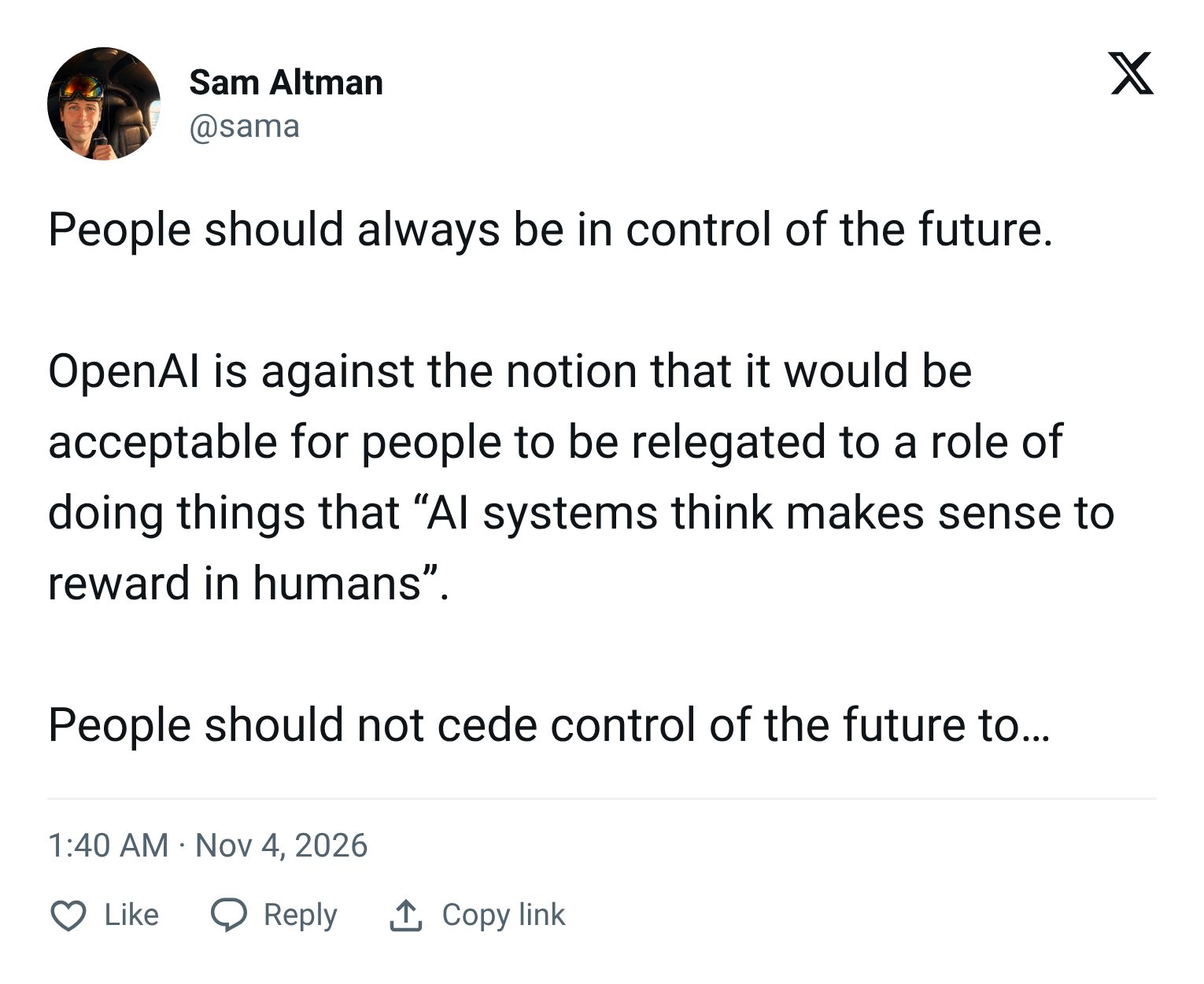
Perhaps the best tweet of the genre was from X’s former head of product, Nikita Bier, comparing AI researchers to Nazis after World War Two for some reason:

For his part, Musk made a half-assed joke intended to self-deprecate over his election-purchasing efforts and that was that. I get the sense that AI executives more broadly are indeed trying to process, in real time, exactly how much trouble they’re in – for trying to influence elections, for throwing in unabashedly with the Trump administration, for developing and deploying their products with utter disregard for the social, economic and cultural costs for everyone else. There is, after all, an open door here, and a groundswell of support for curbing the power of Silicon Valley, for reining in the AI industry, for holding the lot of them accountable. Ultimately, the answer to that question – how much trouble they’re in – will be up to us to answer.
Brian Merchant is a US technology journalist whose most recent book, Blood in the Machine: The Origins of the Rebellion Against Big Tech, was published last year and can be ordered at discount price from the Nerve Bookshop here. This column was originally published on his Substack Blood in the Machine