

Michael B. Jordan and Delroy Lindo on stage at the Baftas on Sunday.
On Sunday night, the 79th Bafta ceremony took place, where Sinners’ Ryan Coogler made history as the first Black winner of Best Original Screenplay. I Swear’s Robert Aramayo also became the first actor to take home Rising Star and Best Actor on the same night – a major feat for the Hull actor, who beat Hollywood favourites Leonardo DiCaprio and Timothée Chalamet to the latter prize.
Both winners represent two films that break boundaries for marginalised groups: Sinners is an epic Black-made, Black-led, anticapitalist genre critique of white supremacy. I Swear offers an empathetic portrait of what it means to live with Tourette syndrome (TS) through the eyes of Scottish activist John Davidson, played by Aramayo. Yet because of an unforgivable error by the BBC, a historic night for representation will be remembered for one thing: two films and communities pitted against each other by selective editing.
The ceremony commenced at 5pm at the Royal Festival Hall in London, where Davidson was attending with team I Swear. He was soon heard uttering uncontrollable outbursts of obscene language as a result of the coprolalia associated with his condition, which affects around 10% of people with Tourette syndrome. Bafta said it had taken decisions “from a position of inclusion”, which is correct. People should not be excluded because of their disability.
I hosted a Q&A screening for I Swear in October, featuring Davidson. Ahead of the panel, I spoke with the distributor about how to handle the discussion if his tics involved racial slurs that might offend people of colour, like me, in the room. A big point of the film is that people with TS shouldn't apologise for what they cannot control, so if tics did involve slurs, the audience would have that context fresh in their mind. They would understand that any profanities uttered would be unfortunate but not a direct attack. At that screening, there were tics involving slurs, and those few people of colour in the room sat there with commendable grace. But that was a small, closed-room screening – not a massive, publicly televised event where the audience hadn’t just watched the film in full.

Robert Aramayo accepts the leading actor award for 'I Swear' - based on the life story of John Davidson - at the Baftas on 22 February. Photo: Stuart Wilson / Getty
In advance of the BBC recording, Bafta announced to the auditorium that Davidson’s tics were involuntary and not a reflection of his personal beliefs, which he confirmed in a statement on Monday: “I was heartened by the round of applause that followed this announcement and felt welcomed and understood in an environment that would normally be impossible for me.”
But when Delroy Lindo and Michael B Jordan presented the first award, he, regrettably, shouted the N-word. It wasn’t his first profane involuntary tic of the night, but it was arguably the worst thing to hear while two Black people were on stage. To Lindo and Jordan’s credit, they remained composed. Davidson says he chose to leave the room when his tics became too distressing for guests, and host Alan Cumming offered an explanation for the “strong language in the background”.
Yet when the ceremony aired on BBC One at 7pm, the incident and the slur were broadcast into people’s homes without any redaction. Soon, the scene had been clipped and shared online, spreading like wildfire and stoking upset among viewers around the world. “Tourettes” became a trending topic on X; the Black community were understandably disgusted by the slur; and soon social media feeds were filling up with an onslaught of hot takes both against Davidson and against those who had been offended.
While this was all going on, I noticed something. On Instagram, I had watched the speech given by Akinola Davies Jr after he and his brother Wale Davies had won the Bafta for Outstanding Debut for their film My Father’s Shadow. His closing remarks were: “Archive your loved ones. Archive your stories yesterday, today and forever. For Nigeria, for London, the Congo, Sudan, free Palestine.”

Around 11pm, I searched on X for any mention of it. There was none, because the BBC had chosen to cut it from the televised broadcast. They had also cut Cumming’s remarks comparing Zootropolis 2’s political themes to the current US administration. For what it’s worth, I have previously written about Zootropolis 2 having more in common with the plight of Palestine, but the fact that the BBC saw fit to censor those political statements and not a racial slur that demeans Black people shows an extreme lack of care, and selective outrage on the corporation's part.
I posted about the hypocrisy late on Sunday night. By the next morning, the post had gone viral, with more social media users, celebrities and media outlets responding to the matter. Explanations and apologies soon followed.
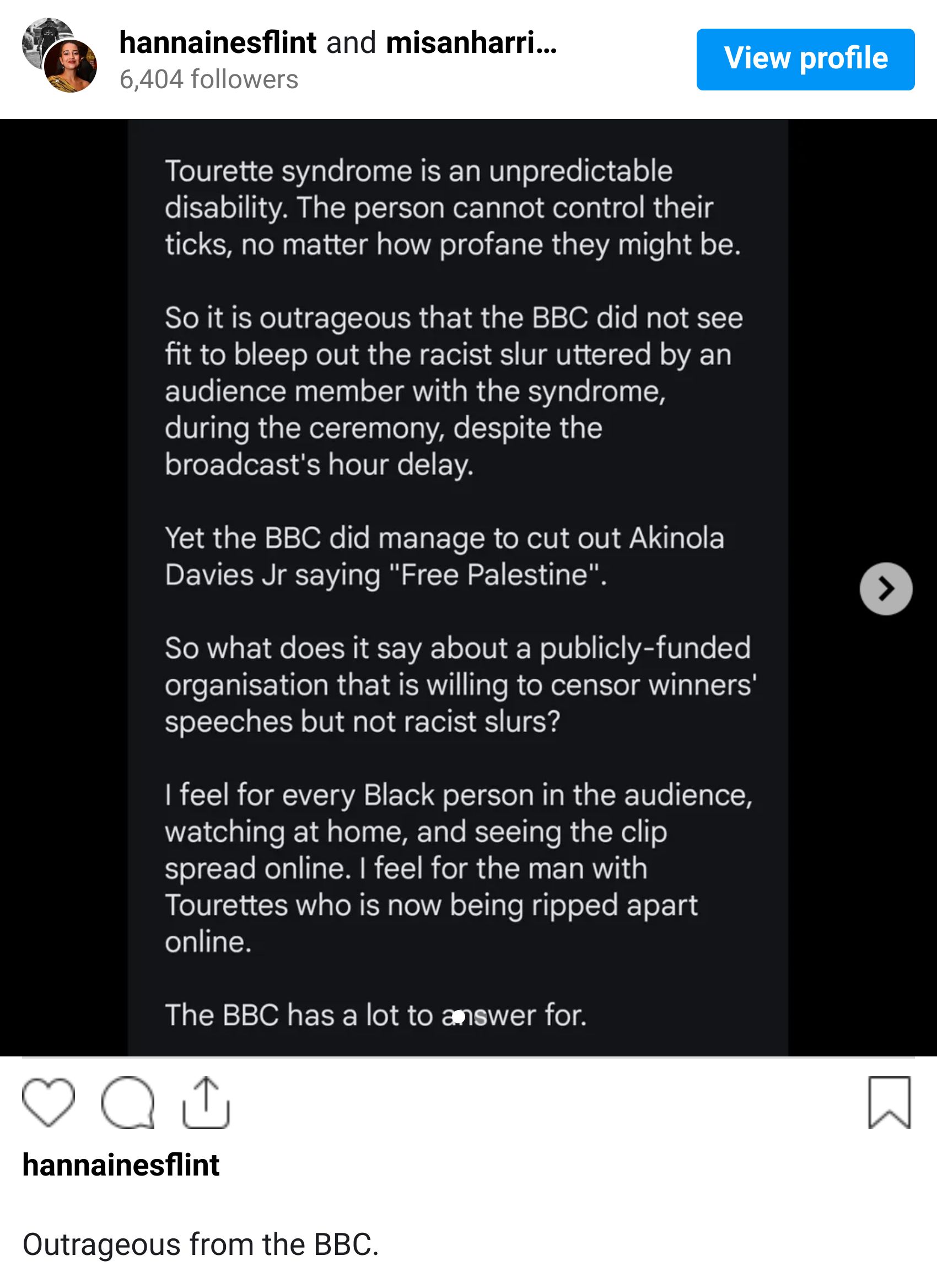
The BBC removed the live broadcast from iPlayer, and the Guardian reported that the producers simply hadn’t heard it because they were in the back of the truck. Really? That excuse might fly if there had not been a two-hour delay, other bits of profane language and political speeches had not been edited out, and Bafta hadn’t sent Cumming out to address the incident. That, and a Deadline report last week, suggests the BBC was working with Bafta to be on “high alert” for not just political comments but instances where Davidson’s tics might emerge. So is the BBC admitting incompetence, or something more sinister? I’d bet good money that if Davidson’s tic had been “Free Palestine”, they'd have caught it. The BBC's own guidelines for racial language say “there must be exceptional editorial reasons to use the strongest racist terms”, but clearly those rules went out of the window.
No doubt a fair few Bafta guests hadn’t seen I Swear either, but it doesn’t minimise the traumatic experience for Black attendees, including the Sinners team. Bafta offered its apologies and thanks to Lindo and Jordan for their “dignity and professionalism” the morning after. But, as Lindo confirmed to Vanity Fair, they did not check in with them immediately after the incident, nor with other Black guests; this makes it all the more galling.
In an intersectional world, a situation like this might never be avoidable – but it certainly didn't need to be televised
Tourettes Action UK addressed “the negative comments that have surfaced following John’s involuntary vocal tics during the ceremony” in a compassionate statement to Far Out magazine: “We deeply understand that these words can cause hurt, but at the same time, it is vital that the public understands a fundamental truth about Tourette syndrome: tics are involuntary. They are not a reflection of a person’s beliefs, intentions, or character.”
People with TS are four times more likely to commit suicide than average because of the social stigma. I hope John Davidson is OK. I empathise with every Black Bafta guest and person worldwide who has had to witness this awful experience repeatedly played out online. I empathise with the people with TS who are witnessing a backlash because of the complexities of their disabilities. In an intersectional world, a situation like this might never be avoidable – but it certainly didn’t need to be televised.
The BBC must take accountability not just for their conscious bias, but for the unnecessary harm to two of the most marginalised groups in the world.
Hanna Flint is a London-based critic, author and broadcaster of British-Tunisian heritage. She co-hosts the Fade To Black podcast and is a co-founder of Cinema for Gaza. Her debut book Strong Female Character: What Movies Teach Us, is available now.