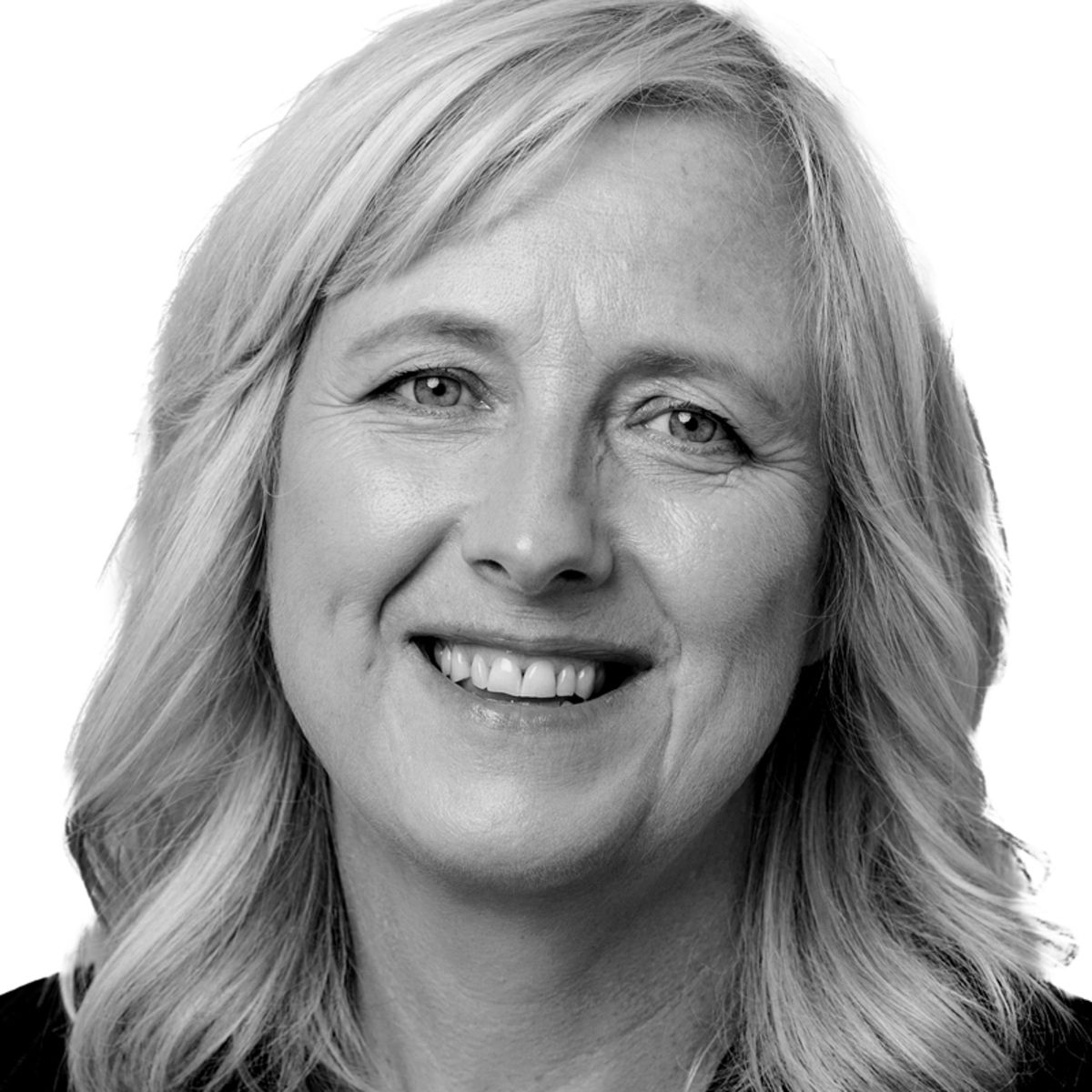

Journalist Amy Goodman. Photo: courtesy Right Livelihood/Wolfgang Schmidt
Amy Goodman is the co-founder and host of Democracy Now!, the independent online news show launched nearly 30 years ago. Now the subject of the documentary Steal This Story, Please!, Goodman has spent three decades reporting from the frontlines of wars, protests and political upheaval around the world.
Carole: The documentary is called Steal This Story, Please! Why that title, and what does it represent to you?
Amy: One of our mottos is "steal the story". I consider an exclusive a failure if we're the only ones telling the story. The point is that the voices we have on Democracy Now! – whether it's someone on the frontlines in Gaza, someone working in AI, or whoever is closest to the story – reverberate around the world.
That's why we say "steal the story, please.” Democracy Now! started 30 years ago when we didn't have the money that the big networks had. It began as a radio show, before the word "podcast" existed, a 59-minute MP3 radio programme.
We expanded into television during the week of the September 11 attacks, it was also the beginning of the internet. We secured democracynow.org, and while the major networks were paying for satellite distribution, we simply posted the programme online.
We don't bring you the typical pundits, the people who know so little about so much, explaining the world and getting it so wrong. We bring you people who are closest to the story. The idea is to have those voices shared as widely as possible.
The documentary itself wasn't my project. It was made by the Oscar-nominated film-makers Tia Lessin and Carl Deal. The title also refers to what happened during our coverage of Standing Rock.
How did Standing Rock become an example of "steal the story"?
Standing Rock was an epic struggle led by Indigenous people in North Dakota against the Dakota Access pipeline [built in 2016 to transport crude from the state’s shale oil fields to a refinery].
We went there expecting to be one of many news organisations covering a historic story. Thousands of people had travelled there from around the world, yet very few journalists were reporting seriously on climate change.
We filmed security guards unleashing German Shepherds on protesters, who called themselves water protectors. One of the dogs had blood covering its nose and mouth after attacking people.
We posted the footage online, and within 24 hours it had been viewed 14m times.
President Obama happened to be in Laos at the time. During a public event, someone asked him about the footage of dogs being used against protesters. When he returned to Washington, I was told he watched the video himself. It wasn't lost on the first African American president what it meant to see dogs unleashed on protesters. After that, every network used the footage. Steal the story, please.

Amy Goodman under arrest while covering the Republican National Convention, 1 September, 2008. Photo: courtesy Rick Rowley/Democracy Now!
This really speaks to the way you look at things differently. It's a very independent ethos, but it's also very generous, because traditionally journalists are competitive and the exclusive is everything. Whereas your point is that you're platforming global voices, people who are closest to the ground, and you want to get those voices out further. Is that right?
Right. And by the way, I don't think they're a fringe minority. I don't even think they're a silent majority. Those who care about war and peace, climate change, racial and economic justice, the immigrant crackdown, LGBTQ issues, about inequality – they're not a fringe minority or a silent majority. They're the silenced majority, silenced by the corporate media.
Which is why we have to build a whole network of independent radio, television and online news sources around the planet. As reporters, we know no borders. We care about getting out the word of people all over the world.
Just explain, for people who aren't familiar, what Democracy Now! is. It's your flagship hour-long programme. It's international reporting on the major issues around the world. And it's also the name of the show itself, right?
It's the show. It's the daily grassroots, global, unembedded, independent, international news hour. It airs every weekday, it's online, we have a mass social media audience, because, very early on, we started online as well as on radio.
I remember asking someone at Fox who worked on the tech side: "Can you just look at our website?" He said: "Are you kidding? All the networks are looking at you."
I remember when Time magazine put something like $20m into its first website and put up a paywall. First mistake. We have no paywalls. It really didn't succeed, and we went the other way.
We were growing on radio stations, and now we're on 1,500 public radio and television stations around the world. But social media has given us a mass audience of millions because we never said "if you think we're important, you should come to us". We felt we needed to be where everyone is, whether that's YouTube, Instagram, TikTok or Facebook.
What matters is that we get out the news, produced by deeply committed journalists, producers and videographers who care about fair, independent reporting. It's brought to you not by the weapons manufacturers when we cover war and peace, not by the oil, gas and coal industry when we cover climate change, not by the banks and financial institutions when we cover inequality, but by the listeners, the viewers and the readers, it really is a mass audience.
As we lay there with guns to our heads and they shouted ‘Are you from Australia?’, I shouted back: ‘No.’ it was important they knew we were from the same country their weapons came from
There are some wonderful scenes in the documentary from different stories you've covered over the years. One I particularly loved is where you're really annoying somebody in a White House press briefing by asking tough questions. One of the journalists says there's always a trade-off – that the tougher your questions are, the less access you're going to get.
It seems to me that you're doing the opposite of access journalism. I suppose I'd love your critique of it, because, reporting on technology companies, it often feels to me that access is the enemy of good journalism.
I call it "the access of evil", a play on the "axis of evil". It's trading truth for access. That scene in the White House briefing room was with Mike McCurry, President Clinton's spokesperson. It was five years after the massacre I survived in East Timor.
That island nation, about 300 miles north of Australia, was occupied by Indonesia from 1975. Britain armed Indonesia, and so did the United States. The US provided 90% of the weapons for the invasion in December 1975. It was one of the great genocides of the late 20th century. Indonesia killed a third of the population of East Timor. In 1991, I was there with my colleague, Allan Nairn, a journalist for the New Yorker.
The Indonesian military marched up on a peaceful procession carrying US M16s. Thousands of people were there. They opened fire, gunning people down from right to left. They killed more than 270 people, they beat me to the ground, Allan threw himself on top of me to protect me, and they took their M16s like baseball bats and slammed them against his skull until they fractured it.
We lay on the ground while they were killing people all around us. They put guns to our heads and shouted: "Are you from Australia?"
We knew what had happened in 1975, when the Indonesian military murdered a group of Australian-based journalists in Balibo. The Australian government barely protested because, years later, Australia and Indonesia divided up the oil in the Timor Gap. Oil is the source of so much pain.
As we lay there with guns to our heads and they shouted "Are you from Australia?", I shouted back: "No." We understood how important it was that they knew we were from the same country their weapons came from. They would have to pay a price for killing us that they never had to pay for killing the Timorese. They moved on.
Five years later, I was at the White House press briefing because a nationwide movement had grown up opposing US military support for Indonesia. Congress had cut off military training for Indonesia, and we understood that President Clinton was about to restore it.
So I kept asking Mike McCurry why. He said it was "in the US interest". I kept pursuing the question until he finally said "the turnip is dry", but what disturbed me even more than his refusal to answer was the tittering, the giggling, of the journalists around me.
I teach young people every day when they come to Democracy Now!, and peer pressure is a huge issue. You have to stand up for what you know is right. When journalists become too closely aligned with those in power, we stop challenging them.
It's such a powerful scene. And the scenes from East Timor feel very foundational to everything you've gone on to do, especially exposing the effects of US power around the world. I think you say in the film that for 17 years not a single US television network covered East Timor.
The day after Indonesia invaded East Timor, President Ford and Secretary of State Henry Kissinger flew from Jakarta, where they'd effectively given [Indonesia’s President] Suharto the green light, to meet another dictator, Ferdinand Marcos, in the Philippines. Once Suharto had the go-ahead, Indonesia invaded by land, sea and air; for the next 17 years, they wiped out a third of the population. ABC, NBC and CBS, the major broadcast networks at the time, never mentioned East Timor.
It's an incredibly shocking statistic, and then your reporting helped change that.
Well, after the massacre, when we got out, we knew the Indonesian military would deny it had happened. As we went into hiding, before catching the only plane out that day, we asked someone to take photographs of Allan and me: Allan was covered in blood.
At first they said maybe 10 people had died, then maybe 50, eventually it became clear that more than 270 people had been killed. I was later captured trying to get back into Indonesia on my way to East Timor and was jailed.
In 1999, the people of East Timor finally got to vote for their freedom in a UN-sponsored referendum. I wasn't allowed in – I was deported – but Allan did get in. As the Timorese voted for independence, Indonesia burned much of East Timor to the ground and killed another 1,000 people. For the next three years the UN administered East Timor, then, in 2002, Allan and I were both able to return.
We were there when Xanana Gusmão, who had spent years imprisoned by Indonesia, became the founding president of the Democratic Republic of East Timor. A hundred thousand people gathered outside the parliament: you could see the fireworks reflected in their tear-stained faces as he addressed them in four different languages.
They had resisted, they had won – at an unimaginably high price, a third of their population killed – but they also had a lesson to teach all of us, whether we're journalists, artists, teachers, doctors or nurses.
Every day we have to decide whether we represent the sword or the shield. People around the world often see ordinary people in countries like the US and Britain as the shield, even if they see our governments as the sword, whether that's bombing countries directly or supplying weapons to regimes that abuse human rights. Every one of us has to decide which we want to represent in the world.

Amy Goodman and Allan Nairn in East Timor in 1991 following a massacre of unarmed Timorese civilians by the Indonesian Army. Photo: courtesy of Democracy Now!
Now we're faced with what feels like a spectacle in the White House. We've seen the White House Correspondents' Dinner, and it also feels as though the corporate media, which for all its faults still looked powerful, well-funded and well-resourced, is collapsing. It feels as though these organisations are falling like skittles because they're being bought up by allies of President Trump.
Can you describe what you think is happening in the media at this moment?
First of all, President Trump calls the media "the enemy of the people." Nothing could be further from the truth. Of course, most of what he says couldn't be further from the truth. Just look at the circle behind him on Inauguration Day – there were these billionaire tech bros who didn't always support him, but now they do, and they're buying up so much.
Jeff Bezos, the billionaire founder of Amazon, bought the Washington Post. During his ownership they developed the motto "Democracy Dies in Darkness", which is true – but it's very dark at the Washington Post right now: they've laid off around a third of the newsroom.
Then you have the corporate media mergers, when CBS announced that Stephen Colbert's late-night show would be ending; [CBS’s parent] Paramount was trying to merge with Skydance. Trump's Federal Communications Commission approved the merger.
Trump had also sued CBS over an edited interview with Kamala Harris. It was a ludicrous lawsuit, I don't think it would have stood up in court. Instead, CBS paid him $16m. They caved. ABC paid $15m rather than fight.
It's actually a very efficient strategy. Instead of going after the weakest media organisations first, Trump goes after the strongest: when they cave, it sends a chill through the entire media.
People around the world often see ordinary people in countries like the US and Britain as the shield, even if they see our governments as the sword
One thing that really struck me is that you've often been criticised by people saying, "You're not a journalist, you're an activist." I've had exactly the same criticism myself. What's your answer to that?
First of all, that was a local Fox journalist saying that. The very next scene in the documentary is me climbing over a fence because journalists were being arrested during the Republican Convention in Minneapolis. I am active, that's for sure: I have to chase politicians, I have to jump over fences to get the story.
But the word "activist" is used to denigrate journalists. We certainly cover activists – people who risk their lives, and often lose their lives.
As journalists, it's absolutely critical that we go to where the silence is, that we get as close to the story as we can. That's why the highest officials try to denigrate journalists. I don't see that label as an insult.
I see the media as a huge kitchen table, like the one I grew up around, except it stretches across the globe.
Anything less than that is a disservice to the servicemen and women who can't have those debates on military bases about the decisions being made, whether they're sent to kill or be killed. Anything less than that is a disservice to a democratic society.
Where do you see America right now? Do you feel the tide is turning on Trump?
I do feel the tide is turning, and I'm inspired by the people I interview and by the people I work with. In Steal the Story, Please! you see many of those people, from Juan González, with whom I co-founded Democracy Now!, to Jeremy Scahill, Sharif Abdel Kouddous and Nermeen Shaikh, who co-hosts the programme with me. These are people who inspire me, and so do the people we cover.
When I was reporting from East Timor all those years ago, I was inspired by the extraordinary bravery of the people there.
Look at the journalists in Gaza: hundreds have been killed, their courage is extraordinary. We don't have the luxury of stepping back: it's too important and I do believe the tide is turning.
I think that whenever we show people the reality of what's happening on the ground, things begin to change.
Finally, Amy, what do you hope people take away from the film?
I hope people come away believing that this model of journalism is possible: that independent media isn't some idealistic dream. It can work, we've been doing it for 30 years. The film isn't really about me: it's about all the people who make Democracy Now! possible, the journalists I work with, the people we cover, and the communities that support us. I hope people leave thinking "we can do this where we live". Whether you're in the United States, the UK or anywhere else, you don't have to wait for the corporate media to change. You can build something different, you can build media that's accountable to people instead of power. That's what democracy needs.
The Nerve is supporting a screening of Steal This Story, Please! on Wednesday 12 August at Bertha DocHouse, Curzon Bloomsbury, London WC1 at 6.20pm. The film will be followed by a conversation with Amy Goodman plus co-directors Carl Deal and Tia Lessin moderated by Carole Cadwalladr. Buy tickets here.
