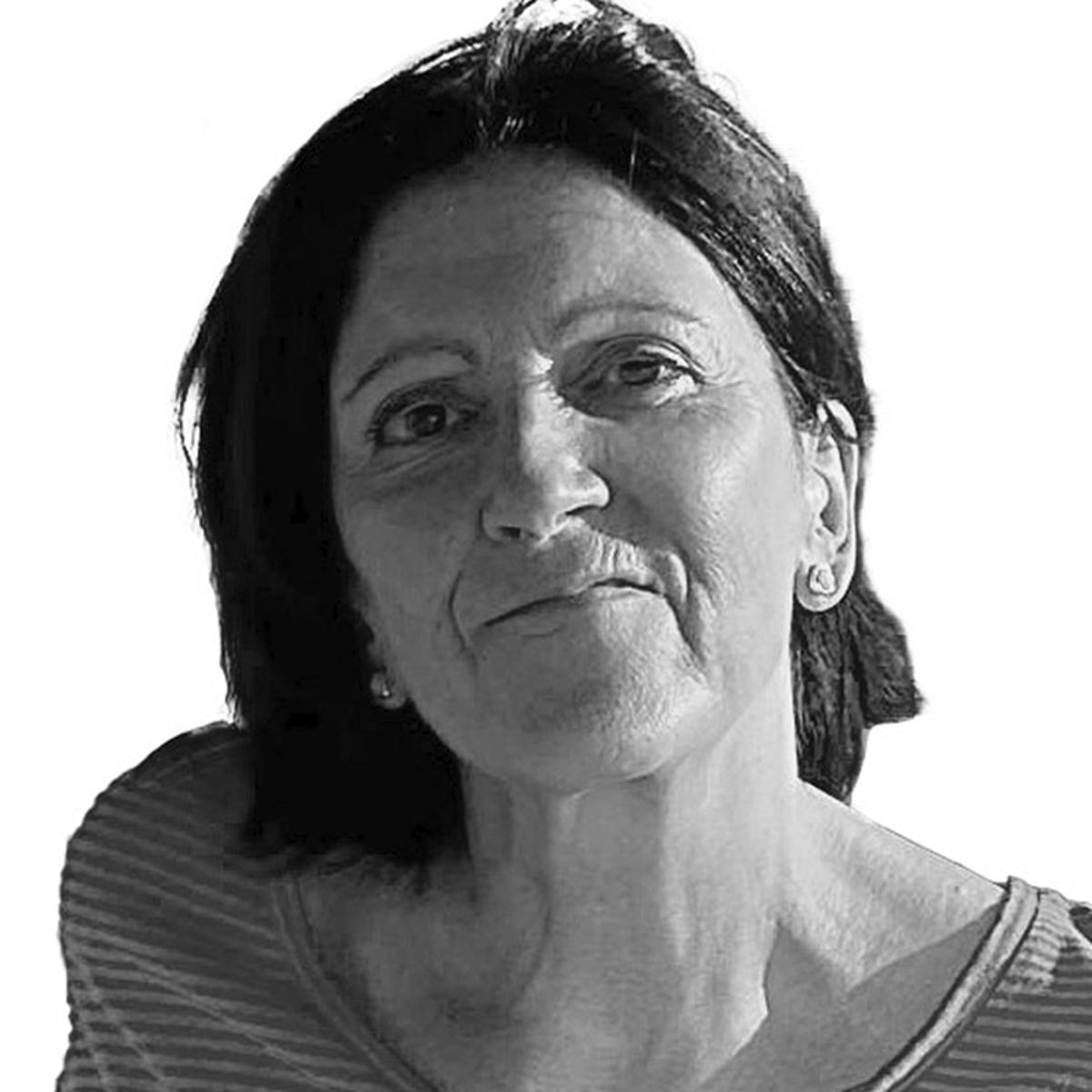

Philippa Perry. Photo: Kate Green/ Getty
The psychotherapist Philippa Perry is also an artist, TV and radio presenter, and the author of four books of non-fiction, including bestsellers The Book You Wish Your Parents Had Read and The Book You Want Everyone You Love* To Read (*And Maybe A Few You Don’t). Early on she worked briefly at McDonald’s, and as an enquiry agent, but eventually found seeing a therapist “life-changing, inspirational – so I thought ‘I will spread the word to the world’, which is what I’ve done”. And continues to do. Now she’s written her first novel, Shrink Solves Murder – a cosy crime caper – and the claim on its cover that she is “the nation’s favourite therapist” is not overblown.
The novel’s shrink is Patricia Phillips, a middle-aged psychotherapist who lives with Dave, her attack cat, in “Westlinke”, an East Sussex village near Beachy Head and Seven Sisters. For a therapist, Pat is pretty grumpy and judgmental (beware dog walkers who let their pets off the lead around the sheep, also those who affect to be “cold water” swimmers rather than, you know, swimmers). Luckily, she is also tenacious, so when the body of one of her clients, Henry Clayton, is found washed up on the beach at Birling Gap and the police insist that it is suicide, Pat is sure that they are wrong, sure in fact that he was murdered, and, together with her friend and neighbour Prichard Knowles (retired, home brewer, good egg), sets about finding out whodunnit. This involves turning a beady eye on Westlinke’s gloriously eclectic mix of locals – swingers Malcolm and Fi, Boho Golf and Spa developer Dorna and Henry’s glamorous but feckless boyfriend Derek. It’s a good yarn and Perry is already on to book two.
Nowadays she doesn’t do private practice herself. “I don’t miss it. I loved it when I was doing it, but I [also] dreaded it.” Instead she is an agony aunt – formerly for the Observer, now in a Substack called Ask Philippa – and she writes a monthly column for the Nerve.
Like Pat, she has a house in East Sussex, but her home is in north London, where she lives with her husband, the artist and broadcaster Grayson Perry.

Philippa and Grayson Perry attend the Serpentine Summer Party 2025. Photo: Alan Chapman/Dave Benett/Getty
Why did you want to write fiction?
Well, I first met my husband at a creative writing course [in 1987] and I've always been sort of circling around the idea of writing a novel. I did my non-fiction books, and I kept thinking “I want to write a novel”. And then suddenly I realised: “My God, I'm 66 and I haven't written that novel yet. I need to pull my finger out.” I read a lot of EF Benson's Mapp and Lucia [also set in East Sussex], Agatha Christie, Richard Osman … I wanted to join in, especially when Richard Osman and then Richard Coles wrote whodunnits.
Do you think you would make a good sleuth?
No, I'd be terrible. Why? Er … Iazy. You know, my morals aren't that high that I have to right every wrong. I'd rather make up a story about a sleuth than be a sleuth.
The book is a lot of fun but there is also a central, serious issue: Henry Clayton might have taken his own life. You worked at the Samaritans for a while.
I was at the Samaritans for about four or five years, and I think it really moulded me as a therapist, in that my number one goal was that I wanted to make people think life was worth living – or at least, you know, you're a long time dead so let's live it out. That's always been my goal as a therapist, to prolong life. And it's [also] because of the cliffs – I live near those cliffs and there are [a number of] suicides every year. That's why it's in my head.
There's this inference, from a character, that Pat has somehow failed as a therapist if her patient has ended their life. How responsible did you feel?
Well, I'm retired as a therapist now, but I think I did fail people when I was a therapist, for sure. Sometimes I wasn't the right match. Sometimes my own agenda would get in the way of the client's agenda. I was not a perfect therapist. And all therapists are a bit like that. You know, we can't “meet” [connect with a client] every time – we “miss” – but as long as we meet enough of the time that's sort of good enough, a bit like [psychoanalyst Donald] Winnicott's theory of a “good enough mother”.
What I like about Pat is, not only does she sometimes miss her clients, she wasn’t the best mother. [But] what she did do was repair that with her daughter.
I had, like everybody else, a disastrous first marriage. But I look back on it quite fondly
What kind of parents were you and Grayson?
We went by the book – as in The Book You Wish Your Parents Had Read. We were not like Pat. The relationship we each have with our child is the most important thing. More important than whether she cleans her teeth for 30 seconds. I've got a good relationship with my daughter now.
Do you feel a lot of similarities to Pat?
If I see someone among the sheep without their dog on the lead I'm quite similar, though much more polite. But Pat hasn't got as much oestrogen as me. I've been slapping on the patches, so I've got this oestrogen that gives me a little bit more patience than people not on the patches. That's made her very straight-talking: maybe a little too straight-talking.
Are you a ‘cold water’ or otherwise swimmer?
Yes. I go twice a week or something when I'm down there [in East Sussex], but I've just had a heated swimming pool put in my garden, so I am very much more of a “swimmer” these days, rather than a “cold water swimmer”.
Do you think you and your family would fit in in Westlinke?
I've been to local art classes. So that was good research. Me and my friends down there do talk about books. But we haven't got an official book club [as in the novel].
And you're not swingers?
No, I'm afraid I had to make some things up.
Talking of the book club, Sally Rooney gets a bit of a kicking …
Sorry, Sally. She's a very popular novelist and I've never really got on with her books. And I think what it is is that she's writing for young people. She's writing for people at university in the throes of their first loves, and she's putting all their complex inchoate feelings into words for them. When you get a bit older – I am 68 – you just think, “yeah, yada yada yada”. Anyway, I've given her a plug and I also gave my fellow stablemate EL James a plug as well.
Have you sold the TV or film rights?
I'm in talks. It's very exciting.
And who would you like to play Pat?
Ideally, my dream would be Jennifer Saunders. Or Joanna Scanlan. Or somebody that hasn't got a posh accent, somebody that's a bit sort of northern like me [she is from Warrington].
What do you wish you'd known at 18 that you know now?
Don't be who you think you ought to be, be who you really are. I am who I really am now, but I used to do too much of trying to over-adapt to situations I was in, so I'd get lost.
Tell us something that's given you hope over the last few months.
What's given me hope is that spring came around again and the cherry blossom came out, and as the leaves come out on all the trees, they're all slightly different colours of green. By midsummer, they all get to the same colour of green. I love noticing that every year. Whatever stupid things humans do, hopefully a few trees might survive.
What would you say to someone who's struggling to be optimistic right now?
Keep a gratitude journal. It sounds really trite, but if you write down three things that you are grateful for every night, forever, it's difficult to go “everything is shit”. [Also] if we say “everything is shit”, that is an all or nothing statement; if we say “everything is wonderful”, that is a Pollyanna statement. Avoid polarisations. Avoid things like “everything is …”, “always…”, “you always …”. Be more precise: “It was terrible that my petrol gauge didn't work and I ran out of petrol on the motorway. But on the other hand, the AA did come and save me.” Look on the bright side too.
What or who brings you joy?
Community, being with other people, especially if we're not at a party. Last week, I took the whole week off to do a pottery throwing course. I can hand-build pots, but I've never actually worked on a wheel before. So I went to City Lit [the adult learning centre in London] and signed up for a throwing course, and they've got a beautiful room with about 14 wheels in there, and we all threw the clay on and mucked about with it until I managed to get a pot out of it. What was a joy was learning a new skill, for sure, but also sitting next to someone who's nice, doing the same thing, and just exchanging the odd word. Company without effort is what gives me joy.
What did Grayson think of your pot?
Oh, he was quite impressed.
What's more important, romance or sex?
Romance is an enculturated way of being, isn't it? I mean, flowers? No! You throw them away after a week. Sometimes I put them straight in the bin [laughs]. Romance, no, sex, yes.
Who do you talk to when you feel low?
My husband. He's very good. My daughter's very good. My friends Yoli and Jonny are very good.
How do you relax?
Watching telly. I watch a lot of true crime because it's very inspiring. My favourite is Forensics: The Real CSI on the BBC. So good. I take notes for the books.
Do you have any regrets?
I think I do have regrets. I had, like everybody else, a disastrous first marriage, but you learn a lot. You've got to have your failures in order to know how to succeed, haven't you? So I didn't have a very good first marriage, but I look back on it quite fondly, almost, because I learned such a lot about how not to be.
Shrink Solves Murder is published by Hutchinson Heinemann, £18.99